The AI Agent Infrastructure Trinity: SDK vs. Framework vs. Execution
 Raman
Raman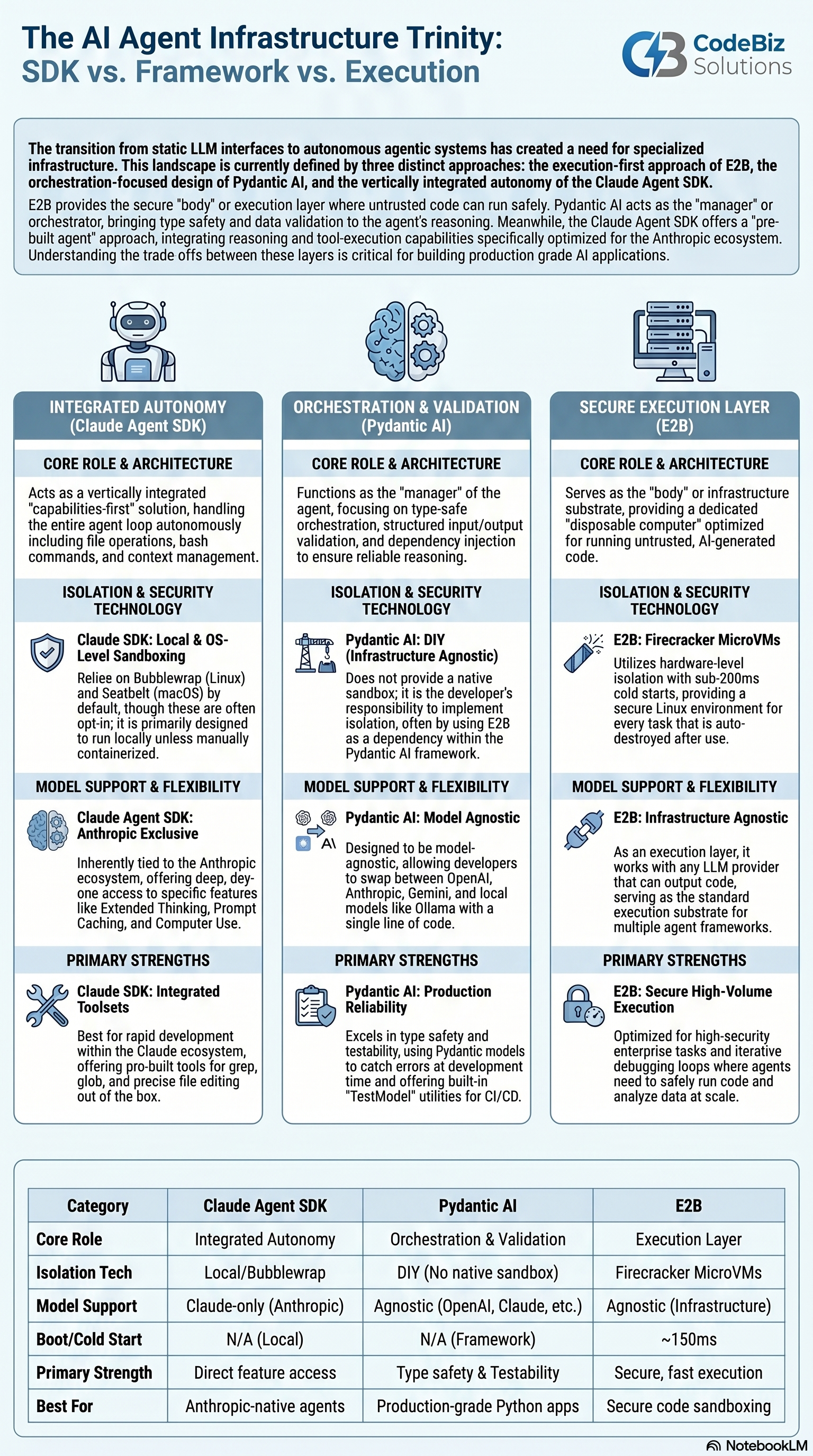
The AI Agent Infrastructure Trinity: SDK vs. Framework vs. Execution
The transition from static LLM interfaces to autonomous agentic systems has created a need for specialized infrastructure. If you're building AI agents, you're likely encountering three distinct approaches: the execution-first design of E2B, the orchestration-focused architecture of Pydantic AI, and the vertically integrated autonomy of the Claude Agent SDK.
Understanding the trade-offs between these layers is critical for building production-grade AI applications.
Three Approaches to Agent Architecture
Think of any functional agent as needing three things:
1. A Manager — the brain that handles logic and reasoning 2. A Worker — the agent executing tasks and making decisions 3. A Safe Space — where code runs without risking your systems
The three major players each approach this problem differently.
---
1. Pydantic AI: The "Type-Safe" Manager
Core Role & Architecture Pydantic AI is the orchestration layer. It acts as the "manager" of your agent, focusing on type-safe orchestration, structured input/output validation, and dependency injection to ensure reliable reasoning.
Isolation & Security Technology Pydantic AI uses a DIY (Do-It-Yourself) approach to isolation — it's infrastructure agnostic. The developer's responsibility is to implement isolation, often using E2B as a dependency within the Pydantic AI framework.
Model Support & Flexibility Model Agnostic. You can swap between Claude, OpenAI, Gemini, and local models like Ollama with a single line of code.
Primary Strengths - Production Reliability: Excels at type safety and testability using Pydantic models for reliable input/output validation - Built-in Reflection: Automatic error correction and retry logic ensures agents recover from failures gracefully - Test-Driven Development: Models are testable via "TestModel" utilities built into Pydantic AI for CI/CD pipelines
Best For Production-grade Python applications where type safety and reliability are non-negotiable. Ideal when you need flexibility across LLM providers.
---
2. Claude Agent SDK: The "Integrated" Pro
Core Role & Architecture The Claude Agent SDK is a vertically integrated "capabilities-first" solution. It handles the entire agent loop autonomously, including file operations, bash commands, and context management — all without you writing the plumbing.
Isolation & Security Technology Local/OS-Level Sandboxing. Relies on Bubblewrap (Linux) and Seatbelt (macOS) by default. This is primarily designed for local development and testing.
Model Support & Flexibility Claude-only (Anthropic Exclusive). You get day-one access to Claude's latest features: Extended Thinking, Prompt Caching, and Computer Use.
Primary Strengths - Integrated Toolsets: Direct access to file operations, bash, extended thinking, and computer use without additional setup - Rapid Development: Built-in loop handling and context management get you from idea to working agent quickly - Deep Feature Access: Day-one support for Anthropic's latest capabilities (Extended Thinking, Prompt Caching, Computer Use)
Best For Rapid prototyping and specialized coding assistants. Teams deeply committed to the Anthropic ecosystem. Ideal when you want to leverage Claude's unique capabilities immediately.
---
3. E2B: The "Secure Body" (The Sandbox)
Core Role & Architecture E2B is the secure execution layer — the "body" or infrastructure substrate. It provides a dedicated disposable compute environment optimized for running untrusted, AI-generated code safely.
Isolation & Security Technology Firecracker MicroVMs. Hardware-level isolation with sub-200ms startup times. Each task gets its own auto-destroyed Linux environment, preventing any possibility of data persistence or cross-task contamination.
Model Support & Flexibility Infrastructure Agnostic. Works as an execution layer with any LLM provider or agent framework.
Primary Strengths - Secure High-Volume Execution: Optimized for enterprise tasks and iterative debugging loops where agents need to safely run untrusted code at scale - Hardware Isolation: Firecracker microVMs provide true hardware-level sandboxing superior to OS-level approaches
Best For Any production system executing untrusted AI-generated code. High-security environments and iterative code execution where agents debug their own output.
---
Quick Comparison Table
| Category | Claude Agent SDK | Pydantic AI | E2B | |----------|-----------------|-------------|--------| | Core Role | Integrated Autonomy | Orchestration & Validation | Execution Layer | | Isolation Tech | Local/Bubblewrap | DIY (Infrastructure Agnostic) | Firecracker MicroVMs | | Model Support | Claude-only (Anthropic) | Agnostic (OpenAI, Claude, etc.) | Agnostic (Infrastructure) | | Boot/Cold Start | N/A (Local) | N/A (Framework) | ~150ms | | Primary Strength | Direct feature access | Type safety & Testability | Secure, fast execution | | Best For | Anthropic-native agents | Production Python apps | Secure code sandboxing |
---
Choosing Your Stack
Use Claude Agent SDK if: - You're building with Claude and want rapid development - You need day-one access to Anthropic's latest features (Extended Thinking, Computer Use) - You're prototyping specialized coding assistants
Use Pydantic AI if: - You need production-grade reliability and type safety - You want to swap LLM providers without changing architecture - You're building Python applications where testability is critical
Use E2B if: - Your agents generate and execute arbitrary code - Security and isolation are non-negotiable - You need sub-200ms spinup times for high-volume execution
The Real Answer: Most production systems use combinations of these. Pydantic AI for orchestration + E2B for secure execution is a common pattern. Claude SDK excels for rapid development within the Anthropic ecosystem.
---
What This Means for Your Projects
If you're starting out, the Claude Agent SDK gets you moving fastest. For production systems where reliability matters, combine Pydantic AI's type safety with E2B's secure execution.
The goal isn't to pick one. It's to understand what each layer does — and choose the right tool for your specific problem.
---
Need help implementing agents in your infrastructure? CodeBiz Solutions builds custom AI solutions for small and medium businesses across Western Canada. Let's talk about your use case →